



What’s actually happening
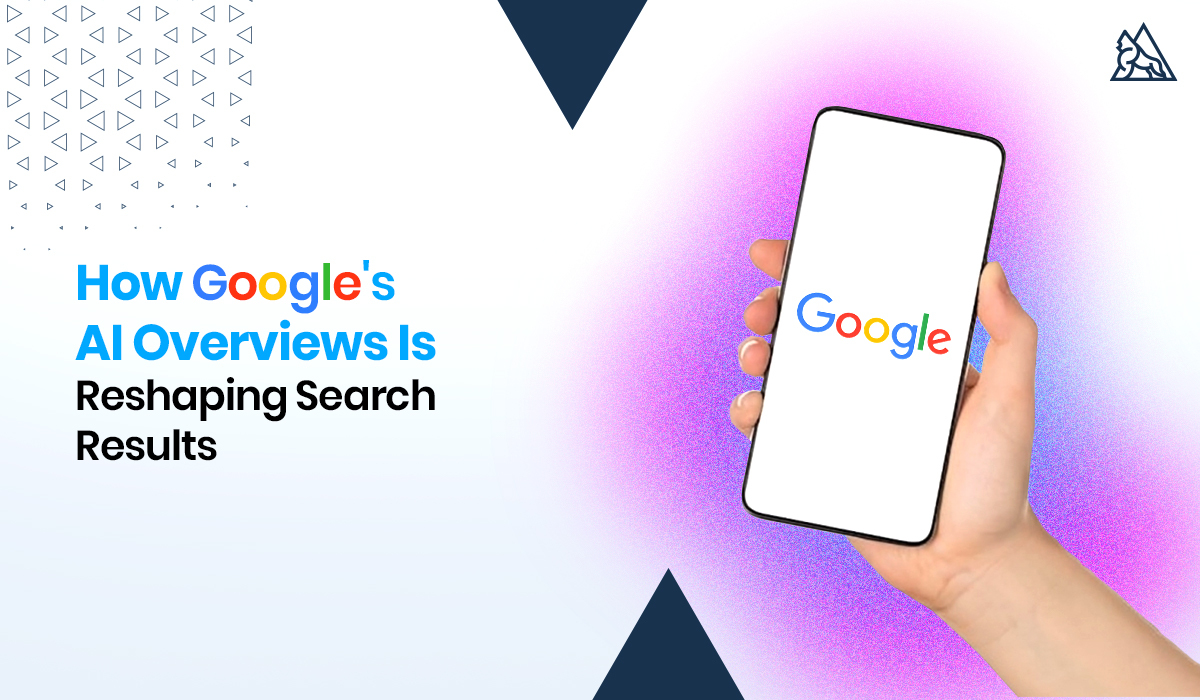
Google’s AI Overviews are transforming search from a ranking system into an answer system.
Instead of rewarding the best-optimized page, Google now:
- Generates answers directly in the SERP
- Synthesizes information from multiple sources
- Reduces the need for users to click any result
This shift fundamentally changes how visibility, authority, and growth work in search.
If your strategy stops at SEO, you’re optimizing for a system Google is actively deprecating.
If you want visibility inside AI Overviews, you need AI-generated answer optimization, Answer Engine Optimization (AEO), and Generative Engine Optimization (GEO).
What Are Google’s AI Overviews?
AI Overviews are Google’s generative summaries that appear above traditional search results for many informational and commercial queries.
Instead of showing:
- 10 blue links
- Featured snippets pulled from one page
Google now presents:
- A synthesized answer
- Multiple cited or implied sources
- A complete response without requiring a click
From a user perspective, this feels helpful.
From a brand perspective, it’s a structural reset.
The Shift: From Ranking Pages to Generating Answers
Traditional Google Search asked:
“Which page best matches this query?”
AI Overviews ask:
“What is the most reliable answer we can generate?”
That distinction matters.
Old system (SEO-led)
- Page relevance
- Keyword matching
- Backlinks
- On-page optimization
New system (AI-led)
- Entity trust
- Conceptual alignment
- Brand authority
- Reusable explanations
This is why zero-click AI optimization is no longer optional, it’s the default outcome.
Why Zero-Click Search Is Now the Norm
AI Overviews dramatically accelerate a trend that was already underway.
Zero-click behavior increases because:
- Answers appear instantly
- Users don’t need to compare sources
- Google handles synthesis
In many queries, the user’s journey ends inside the overview.
That doesn’t mean brands lose influence.
It means influence no longer depends on traffic.
Visibility in AI Overviews ≠ Ranking #1
Many brands still ask:
“How do we rank inside AI Overviews?”
That’s the wrong question.
AI Overviews don’t rank pages, they select sources to think with.
Your content is either:
- Used to generate the answer
- Or ignored entirely
This is the core of AI-generated answer optimization.
How Google Selects Content for AI Overviews
While Google doesn’t publish a checklist, patterns are clear.
AI Overviews favor content that is:
- Explicit
- Clear answers
- Direct statements
- Minimal ambiguity
- Structured
- Logical flow
- Cause-and-effect explanations
- Predictable formatting
- Authoritative
- Strong entity signals
- Consistent topical focus
- Clear expertise boundaries
- Judgment-based
- Not just “what it is”
- But “when it works” and “when it doesn’t”
Neutral, generic content struggles because it offers low decision value.
Answer Engine Optimization (AEO): The Foundation Layer
Answer Engine Optimization exists to solve one problem:
Making your content usable by AI systems as an answer source.
What AEO actually optimizes
- Answers, not articles
- Meaning, not keywords
- Extractability, not clicks
Core AEO characteristics
- Direct answers in the first few lines
- Declarative language
- Clear definitions
- Stable terminology
This is why many SEO-first blogs fail in AI Overviews, they bury the answer under context.
What Are AEO Services (Really)?
Many providers relabel SEO as AEO.
That’s a mistake.
True AEO services focus on:
- Teaching AI systems how to interpret your expertise
- Structuring knowledge, not publishing volume
- Reducing ambiguity in how your brand is understood
They answer questions like:
- What should AI associate this brand with?
- What topics should it trust them on?
- What perspectives are uniquely theirs?
If those questions aren’t addressed, you’re not doing AEO.
Generative Engine Optimization (GEO): Beyond Answers
If AEO is about clarity, GEO is about confidence.
Generative Engine Optimization services help brands:
- Shape how AI systems reason about a category
- Influence synthesis, not just extraction
- Become a lens, not just a source
GEO optimizes for:
- Reuse of your explanations
- Recall of your frameworks
- Consistency of your point of view
AI systems remember patterns of thinking, not one-off facts.
Why Google’s AI Overviews Favor Opinionated Content
This surprises many brands.
They assume neutrality is safer.
In reality:
- Neutral content blends together
- Opinionated content stands out
- Clear judgment signals experience
AI systems are designed to reduce uncertainty.
They prefer sources that already made the decision.
That means:
- Stating trade-offs
- Explaining failure cases
- Saying who should not follow an approach
This dramatically increases selection inside AI Overviews.
SEO vs AEO vs GEO: How They Work Together
These are not competing disciplines.
They’re layers.
SEO
- Helps Google find and index content
AEO
- Helps AI extract answers
GEO
- Helps AI trust and reuse your thinking
You still need SEO.
But SEO alone no longer creates visibility.
The New Measurement Problem (And Why It’s Normal)
AI Overviews break traditional analytics.
You may see:
- Lower organic traffic
- Fewer clicks
- Stable or growing revenue
This feels wrong if traffic is your KPI.
But influence is happening:
- Before the click
- Without attribution
- Inside the answer itself
This is why zero-click AI optimization focuses on presence, not sessions.
Common Mistakes Brands Make with AI Overviews
Mistake 1: Chasing inclusion hacks
There is no markup that guarantees selection.
Mistake 2: Writing longer content
Length doesn’t equal usefulness to AI.
Mistake 3: Avoiding strong opinions
Hedging reduces trust signals.
Mistake 4: Treating AI Overviews like featured snippets
They are far more contextual and entity-driven.
When AI Overviews Matter Most
AI Overviews have the highest impact on:
- Informational queries
- B2B research
- Comparison searches
- “How” and “Why” questions
If your buyers research before buying, AI Overviews shape their understanding before they reach your site.
The Long-Term Impact on Search Strategy
Over time, AI Overviews will:
- Reduce visible organic listings
- Concentrate authority into fewer brands
- Reward consistent, opinionated expertise
This creates a widening gap:
- Brands AI trusts
- Brands AI ignores
That gap compounds.
What Winning Brands Are Doing Differently
Brands succeeding in AI Overviews:
- Write answer-first content
- Repeat the same frameworks across pages
- Take defensible positions
- Optimize for reuse, not rankings
They treat content as infrastructure, not campaigns.
Final Takeaway
Google’s AI Overviews are not a feature update.
They are a redefinition of search.
- Ranking is no longer the primary outcome
- Traffic is no longer the primary signal
- Answers are the interface
To win, brands need:
- AI-generated answer optimization to be usable
- Answer Engine Optimization services to be extractable
- Generative Engine Optimization services to be trusted
In the new search landscape, visibility doesn’t come from being found.
It comes from being used.