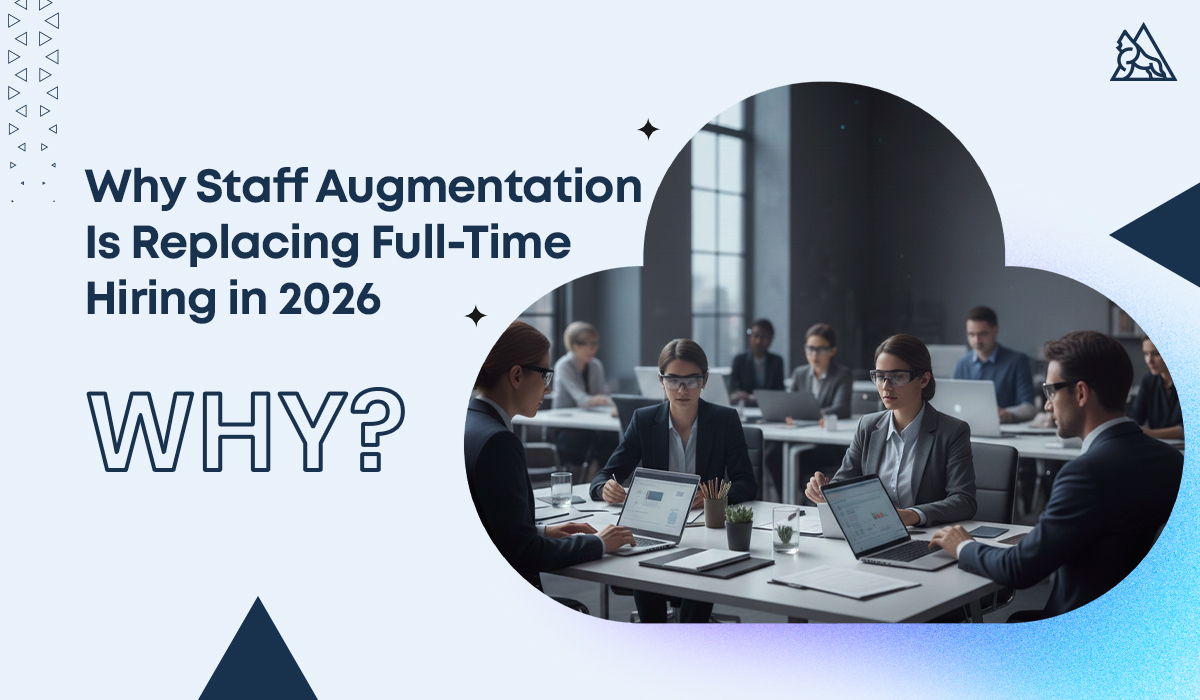




IT staff augmentation services are no longer a backup plan. In 2026, it is becoming the default hiring model for companies that need speed, flexibility, and AI ready teams without the long term cost burden of traditional employment.
As digital transformation accelerates and skills evolve faster than job descriptions, businesses are rethinking how they build teams. The result is a clear shift away from full time hiring toward staff augmentation services that scale with demand and deliver faster results.
What is IT staff augmentation in 2026?
IT staff augmentation is a hiring model where businesses add skilled professionals to their existing teams on a temporary or contract basis. These professionals work under your direction, use your tools, and integrate into your workflows, without becoming permanent employees.
In 2026, staff augmentation is deeply tied to AI readiness. Companies are using it to access cloud engineers, AI specialists, cybersecurity experts, and developers on demand, without waiting months to hire internally.
Cost comparison: full time hiring vs staff augmentation
Cost is the first reason staff augmentation is replacing full time hiring.
A full time IT hire costs over $100,000 per year once salary, benefits, recruitment fees, and overhead are included. Benefits alone add 20 to 30 percent to base salary. Recruitment costs and idle time further increase the real expense.
Staff augmentation delivers 30 to 65 percent cost savings by eliminating these extras. Augmented professionals typically cost between $50,000 and $70,000 annually for short term contracts. Companies also reduce recruitment expenses by up to 45 percent and save approximately $11,000 per employee each year on benefits and non productive time.
This makes staff augmentation services far more efficient for project based work, fast scaling, and specialized skills.
Speed: why augmentation beats traditional hiring
Traditional IT hiring is slow by design.
The average full time IT hire takes 29 to 45 days, with engineers often closer to 30 to 40 days. Even after hiring, new employees typically take six to seven months to reach full productivity.
Staff augmentation compresses this timeline dramatically. With access to pre vetted talent pools, companies can onboard skilled professionals in days or weeks. Projects start faster. Delivery timelines shrink. Business momentum stays intact.
In competitive markets, speed is not a nice to have. It is survival.
Flexibility that full time hiring cannot match
Staff augmentation offers flexibility that full time hiring simply cannot.
The global IT staff augmentation market was valued at $299 billion in 2023 and is projected to reach between $857 billion and $1.07 trillion by 2031 to 2032. This growth reflects how companies now prioritize adaptable workforce models.
Businesses use staff augmentation to scale teams during product launches, seasonal demand, AI initiatives, or digital transformation projects. When demand slows, teams scale back without layoffs or long term payroll pressure.
This flexibility is especially valuable in 2026, where 78 percent of organizations now use AI or machine learning through augmented AI ready teams.
Hiring vs staff augmentation: what actually works better?
Full time hiring works best when roles are stable, long term, and deeply tied to company culture. Staff augmentation works best when speed, specialization, and adaptability matter more than permanence.
For many companies, the winning strategy is not one or the other. It is a hybrid model. Core leadership and institutional knowledge stay in house, while execution and specialized skills are augmented as needed.
This approach reduces risk while increasing delivery capacity.
When NOT to use staff augmentation
Staff augmentation is powerful, but it is not universal.
Avoid using staff augmentation for core systems that require deep institutional knowledge and long term ownership. It is also not ideal for roles focused on strategic skill building or where continuity and cultural cohesion are critical.
Without proper internal oversight, staff augmentation can lead to quality issues or misalignment. It works best when internal teams can clearly define scope, manage output, and integrate external talent effectively.
Understanding these boundaries is what separates successful adoption from frustration.
Why staff augmentation fits AI driven teams in 2026
AI projects demand rare skills and rapid execution. Waiting months to hire internally is no longer viable.
Staff augmentation allows companies to plug in AI engineers, data scientists, and automation specialists exactly when needed. This model supports experimentation, iteration, and scale without committing to permanent roles before value is proven.
In 2026, AI ready teams are built, not hired all at once.
Conclusion
IT staff augmentation is replacing full time hiring in 2026 because it aligns with how modern businesses operate. It lowers costs, accelerates delivery, and provides flexibility in an uncertain, fast moving technology landscape.
Full time hiring is no longer the default. It is a strategic choice used selectively. Staff augmentation services, on the other hand, are becoming the engine that powers growth, innovation, and AI readiness.
Companies that understand when and how to use staff augmentation are not just hiring differently. They are building teams designed for the future.